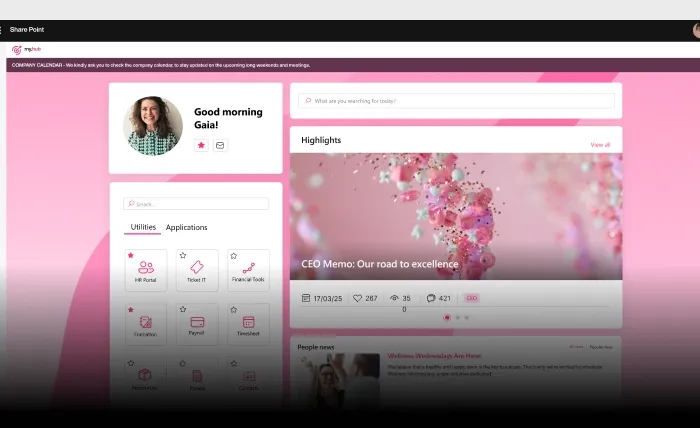
For every new project, our component creates a pre-configured Teams group with your communication and collaboration preferences from the SharePoint intranet.
Discussion and project groups:why your business needs them
Our feature enhances the productivity of business teams, defines communication and collaboration standards for your projects, and simplifies the creation of custom Teams groups.
Why do business projects often get complicated?
- Difficulty in finding content and information.
- Lack of a shared document repository.
- Confused communication.
- Use of different tools for the same project.
- Non-standardized workflows.

Create a unified collaboration experience
- A Microsoft Teams group.
- A conversation area.
- A space to share project files.
- A Planner task board to coordinate activities.
- An area to save meeting notes via OneNote.

Integration with Microsoft Teams

Manage the creation of new groups
Our feature assists in standardizing the workflow for creating custom Microsoft Teams groups from the SharePoint intranet. This, in turn, enhances the productivity of project teams and improves their collaboration experience.

Simple configuration

Projects, groups, and profile in one web part
The web part organizes collaboration into clear tabs: Projects, Groups, and Profile, with an optional Department tab for departmental navigation. Projects are specialized Microsoft Teams groups created from preconfigured templates that include meeting notes and Planner integration, while Groups support general collaboration. Every team your colleagues belong to is mirrored directly in the interface, so people reach the right conversation, files, and tasks without leaving the SharePoint intranet.
Standardized naming and team governance
IT administrators define a custom category prefix that is applied to every project created through the web part, defaulting to "prj" when none is set. The prefix appears in each team's email address, making groups easy to identify and keeping the company archive consistent. Owner assignment is handled automatically or routed to a designated account email, and the creation buttons can be disabled entirely to keep group provisioning under controlled governance.
Documentation
Explore the technical guide for this feature on our documentation site.
Frequently asked questions
What does the Discussion and project groups web part create?
It creates two types of Microsoft Teams entities directly from the SharePoint intranet: Projects, which are specialized Teams groups built from preconfigured templates with meeting notes and Planner integration, and Groups, used for general collaboration. Both are accessible from the web part interface, which mirrors each user's existing Teams memberships.
Who is allowed to create new Teams groups from the intranet?
Users must hold the relevant Microsoft Teams permissions to create groups. When users lack these permissions, intranet.ai recommends disabling the creation buttons. Group and project ownership is assigned automatically or directed to a designated account email defined in the web part settings.
Can we enforce a consistent naming convention for new groups?
Yes. The Category settings let administrators define a custom prefix that is applied to every project created through the web part, defaulting to "prj" if none is specified. The prefix is included in each team's email address, helping IT identify groups and maintain a standardized, well-governed archive of company Teams.
How is the web part configured and published?
The web part is deployed on a SharePoint page, where administrators can toggle the visibility of the Projects, Groups, Profile, and Department tabs, rename tab labels, and set the web part height between 220 and 2000 pixels (500px by default). After configuring, changes are previewed with Save as draft and made available to users by republishing the page.
Related features
The complete SharePoint intranet integrated with Microsoft 365, starting from 3,950 €/year.
- 80+ apps for communication, training, and knowledge sharing
- Compatible with Microsoft 365 and Microsoft Viva
- Operational within 24 hours from purchase, with 5 days of consulting