The Problem: A Structure That Grew Before the Technology Was Ready
When SharePoint did not yet natively manage multilingual content, the only way to offer content in different languages was to create separate sites, each with its own default language.
For a group present in dozens of countries, this meant one site per country. Updating even a single link, in a context like this, requires manually intervening on each of the 27 existing sites, publishing the same content twenty-seven separate times. An operation that today’s technology would allow to be managed with a simple drop-down menu for language selection, but that was not yet available at the moment the infrastructure was built.
Time, in this case, did not make things simpler.
On the contrary, it made the consolidation effort more delicate, because in the meantime each country kept producing content according to its own structure, accumulating years of material that now needs to be mapped, evaluated and partly migrated to the new architecture. Some country sites were managed only in English, others developed entire archives in the local language, so understanding which countries could continue operating in English and which really needed multilingual management became an integral part of the project itself.
Adding to the complexity, the scale of the organisation.
The internal communications team had to manage a very large company, which made every intervention a matter of continuous prioritisation: bringing new departments on board, making the most of the available components, keeping the infrastructure up to date, everything necessarily moving forward one step at a time.
Among the various offerings in the intranet.ai catalogue, keyword search on the home page and the pop-up for important communications remain among the most used tools.
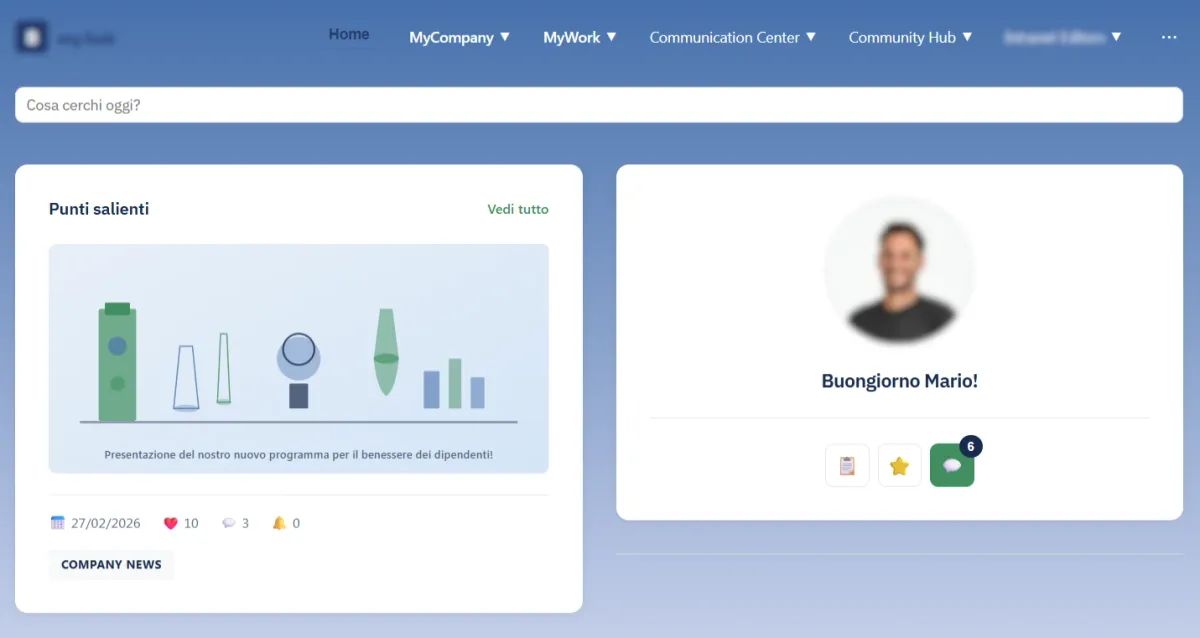
Home page of a pharmaceutical group's intranet
Our Solution: Growing One Department at a Time, With Data as a Guide
The approach adopted over the years has never aimed at a single, definitive transformation, but at a constant evolution, built together with the client one piece at a time.
The first department to be digitised with intranet.ai components was research and development, which still remains one of the most active on the platform today, even though by its nature it reaches a narrower audience compared to other company content. From there the team moved on to the legal & compliance department, then marketing and corporate quality management.
Before tackling the most ambitious intervention, the one on the multilingual infrastructure, we carried out an in-depth analysis, mapping page views and unique users over a period of two years, to build a base of concrete evidence on which to found the restyling choices.
This work made it possible to identify practical opportunities, such as the fact that the contacts page is viewed a very high number of times per day. This data suggested using that space to insert banners and links of greater strategic relevance, without having to intervene on more complex architectures.
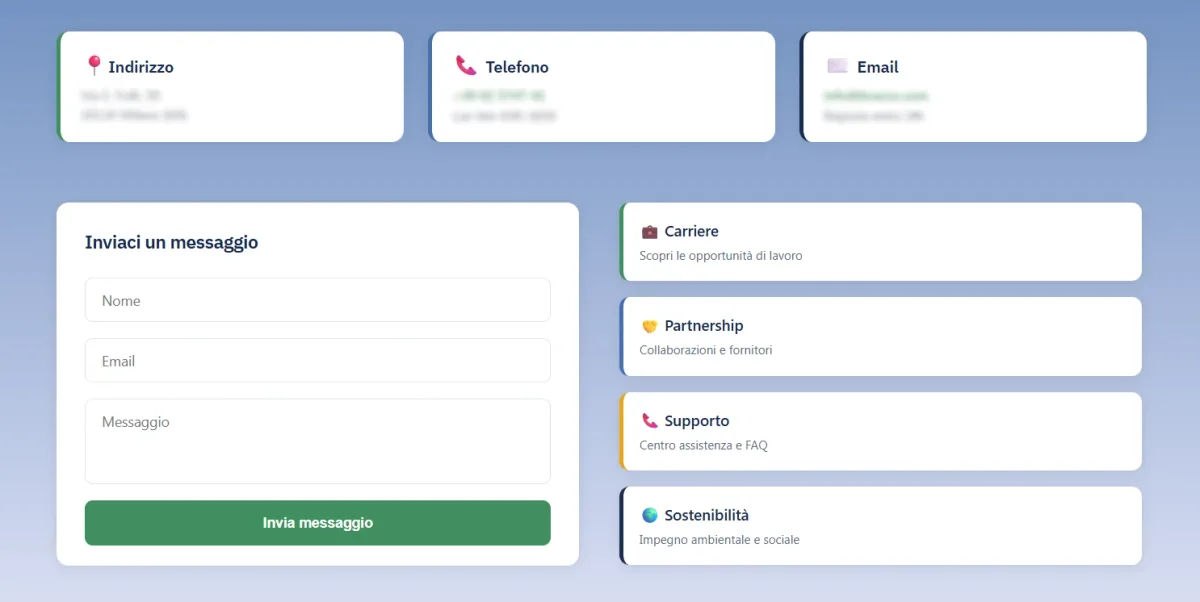
Contacts page in the intranet.ai intranet
Beyond the work on the platform itself, a significant part of the intranet.ai team’s commitment concerns support for live company events.
For the research and development department, events are organised four times a year, and for each one a dedicated page is created with agenda, countdown, call to action and coordinated graphics, along with an interactive quiz moment run with a real-time polling tool, with a winner rewarded and celebrated in a news item published on the intranet and reposted on the company’s internal social feed.
When the event also takes place in person, the support extends to managing the streaming and connecting remote participants, in coordination with the team handling the on-site production.
The support also extends to video production, from recording short messages from department heads for occasions such as year-end greetings, to remote support for larger campaigns involving external professionals, with subsequent editing curated internally.
A level of collaboration that goes well beyond simple platform management, and that has become consolidated over the years precisely because the relationship with the client has never stopped at the delivery of a single project.
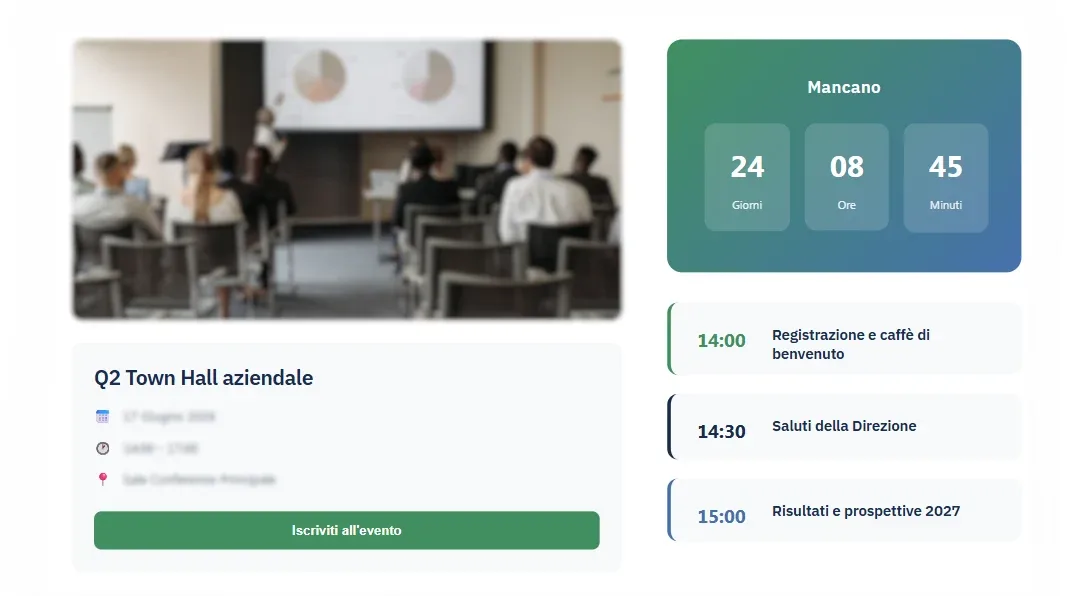
Event communication in the company intranet
The Results: An Increasingly Mature Platform and an Increasingly Solid Partnership
The value of this relationship is measured more in its duration and its capacity for adaptation than in any single indicator.
Each department brought on board represents a small autonomous milestone. The site of research and development remains among the most consulted by its own target audience, the legal & compliance and marketing departments have been completed and successfully released, and the work on the corporate quality management department is proceeding according to the same incremental method that guided all the others.
The analysis of usage data over two years has represented a solid, concrete base on which to build, with greater precision, all the decisions for the next infrastructure intervention, instead of proceeding on intuition alone.
The support for live events has also proven itself over the years to be a high-value service valued by the client, capable of turning every Town Hall or departmental event into a communication moment that is curated, coordinated and consistent with the brand identity, in collaboration with the company’s internal communications team.
What’s Next?
The most relevant project for the coming period concerns precisely overcoming the structure of 27 separate sites, with the goal of consolidating multilingual management on a modern native infrastructure, drastically reducing the work needed to update content shared across the various countries. An intervention that will also require careful work to migrate historical content so as not to lose years of already published material.
In parallel, an update of the company brandbook is planned, with an adjustment of the colours and, for the first time, the possibility of customising the fonts used on the platform, a feature recently made available by SharePoint.
Looking ahead, the team is evaluating the introduction of gamification components, with the idea of using interactive quizzes, together with a digital board designed to collect and showcase the personal moments of each team member, such as photos of their first day in the department compared with photos of today.
When a platform grows together with a company for years, the real value does not lie in a single release, but in the ability to keep evolving it without ever losing what was built before.
Do you manage a global intranet, present in multiple countries and languages, and want to evaluate how to modernise it without losing years of content? Book a demo and find out how intranet.ai can support the evolution of your platform.