
The Problem: Modernising Without Disrupting
Our client’s starting request was to update the underlying technology, moving to a more modern SharePoint Online environment capable of offering more sophisticated document management, without affecting the navigation experience the company was used to.
An airport, by its nature, requires particularly rigorous document management, made up of certifications, safety procedures and a series of document tags essential for correctly organising content. It was precisely this need that had driven the company to consider upgrading its platform.
On the old intranet, the vertical menu was literally embedded inside each page, a solution far from easy to replicate with components designed around a different navigation logic. It was therefore necessary to find a compromise between the previous organisation and a structure that was technically sustainable.
Another specific requirement concerned the company’s social media. A way was needed to display content published on institutional social networks directly inside the intranet, without the user physically being on the social platform, avoiding any risk of direct interaction not allowed by company policy.
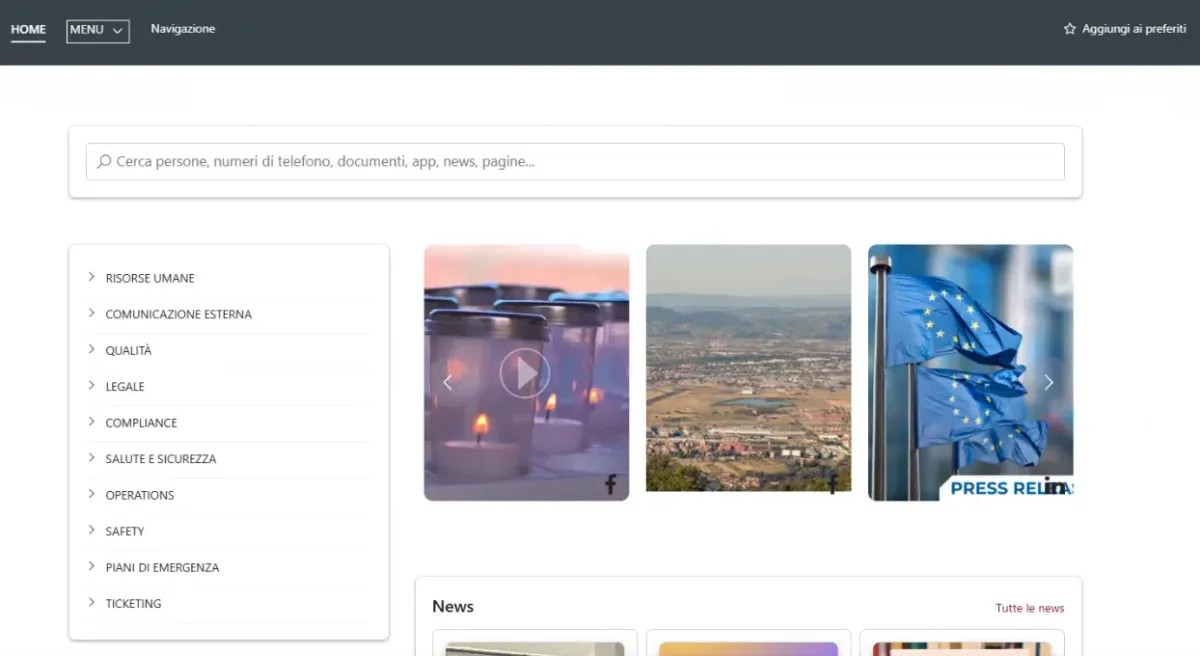
Home page of an airport company's intranet
Our Solution: Two Airports, One Platform, Two Sensibilities
The answer to the vertical menu constraint was found in a concise navigation menu on the home page, linking to genuine mini home pages dedicated to the main business areas, such as HR.
Inside each of these mini home pages there is a button panel that reproduces exactly the same entries present in the old intranet’s vertical menu, allowing users to find their way around with the same logic they were used to, whether navigating from the main menu or moving directly from the home page.
For the social media question, the solution came from an integration tool capable of displaying social content inside the intranet, complete with some statistical data, without the user ever actually being on the external platform. This solution made it possible to respect internal policies while at the same time keeping the freshness and dynamism of social content, updated far more frequently than traditional company news.
In addition, given the strongly operational nature of the company, with staff working both in offices and directly on runways and at airport gates, every page of the intranet was organised with very precise targeting logic.
Only certain groups of employees can view specific content, particularly content related to airport security. Some pages also include direct links to flight display boards, an operational tool of great everyday usefulness for staff.
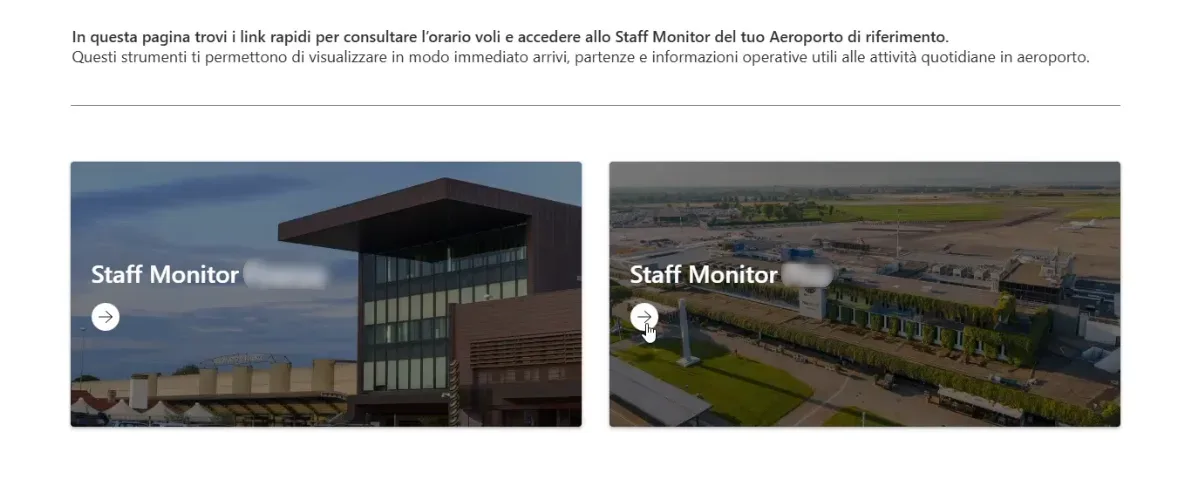
Staff monitor in the SharePoint intranet
Since this is a company that manages two distinct airports, an additional layer of complexity involved separating content and permissions between the two structures.
Even an apparently simple operation, such as connecting the correct groups in the company directory to show the right information to the right people, required considerable precision work, given the importance of security in an airport context.
Among the add-on components most requested by the client, the page navigation menu proved essential to replicate the vertical logic they were used to. Alongside this, RSS feeds were activated to automatically aggregate communications from the company’s official external website, maintaining consistency between public and internal content.
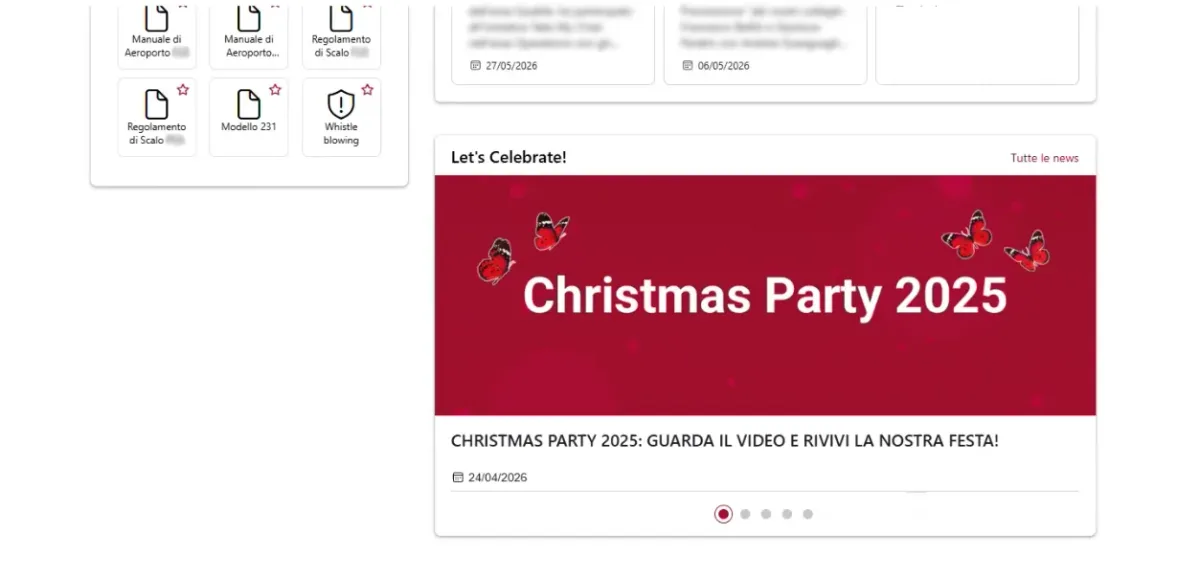
Communications in the SharePoint intranet
The Results: A Change Accepted, Not Imposed
The project was delivered with full success, despite the difficulty of keeping the internal navigation logic unchanged. Both operational stakeholders and the company leadership involved in the project declared themselves very satisfied with the final outcome, a decidedly significant result.
The platform represents a concrete example of how it is possible to modernise a company tool without betraying the habits of those who use it every day.
The most common risk in projects of this kind is letting oneself be guided exclusively by the most modern design logic, forgetting that the real adoption of a new tool depends largely on how oriented people still feel within it.
A balance achieved through careful listening to the client’s real needs, even at the cost of greater technical complexity during configuration, is the most effective solution for the success of any internal digital renewal project.
What’s Next?
The next steps will involve a content enrichment phase, together with a more in-depth evaluation of how to integrate artificial intelligence tools, such as intelligent search or virtual assistants, a topic the company has already started to explore.
Managing separate content for the two airports also remains a topic that will continue to require attention over time, as new content and new security needs arise. A well-defined governance structure from the very start, like the one built in this project, provides the foundation on which to keep building without having to revisit the platform’s fundamentals.
The integration of the company organisational chart, currently still available only as a PDF, is also already planned as a further step in this suite of tools.
Modernising an intranet does not always mean overhauling it. Sometimes the greatest value lies in knowing how to listen to the habits of those who use it every day, and building change around those habits.
Do you need to modernise your intranet without overhauling the habits of those who use it every day? Book a demo and discover how intranet.ai can support your company in finding this balance.