

How can documents shared via Teams be found in SharePoint?
Where do the tips come from that Viva Insights offers to better manage the Outlook calendar?
If you want to know the secret of integration between Microsoft 365 products, this is the right article.
What you will find in this article
What is Microsoft Graph
Microsoft Graph is the REST API that connects information in Microsoft 365.
In other words, it is the interface that unifies the user experience when moving from one work app to another.
Let’s see together how it works.
See intranet.ai in action
A ready-to-use intranet on SharePoint Online, live in days. Book a free demo with our team.
Book a demoWhat are the main features ofMicrosoft Graph
Intelligence systems, data collection, and integrations between apps that are part of the Microsoft 365 ecosystem are enabled by the Microsoft Graph API.
Specifically, we can divide the functionality of this system into 4 macro categories:
-
Document control.In fact, Graph records changes that affect the lifecycle of files created, stored and shared in the Microsoft 365 environment.In this way, it allows users to use information such as the last modification date to organize their archives, whichever app—between OneDrive, Teams and SharePoint—they use.
-
Conversation control.Whether in an email or chat, Graph exposes information exchanged between users to Microsoft 365 apps that can turn it into useful suggestions.One example is Viva Insights, which is allowed to read and interpret data in Outlook to help the individual user better manage his or her schedule, including meetings and events organized via email and saved in the calendar.
-
Personalization of the user experience.Graph gathers content published in its digital workspace and filters it based on user behavior.This gives rise to the Feeds that characterize the SharePoint, Yammer and Viva Engage apps, in which Microsoft’s algorithm arranges not only recent or trending content in the company, but also and especially that which it deems to be most useful for the user and the activities they perform in their Microsoft 365 account.
-
Support for Microsoft Search.Graph expands the scope of searches that users can do in Microsoft 365.It allows them to retrieve content and information stored in the suite’s apps from anywhere in their digital workspace.It also allows Microsoft Search to reach data from external sources, such as a company’s local databases.
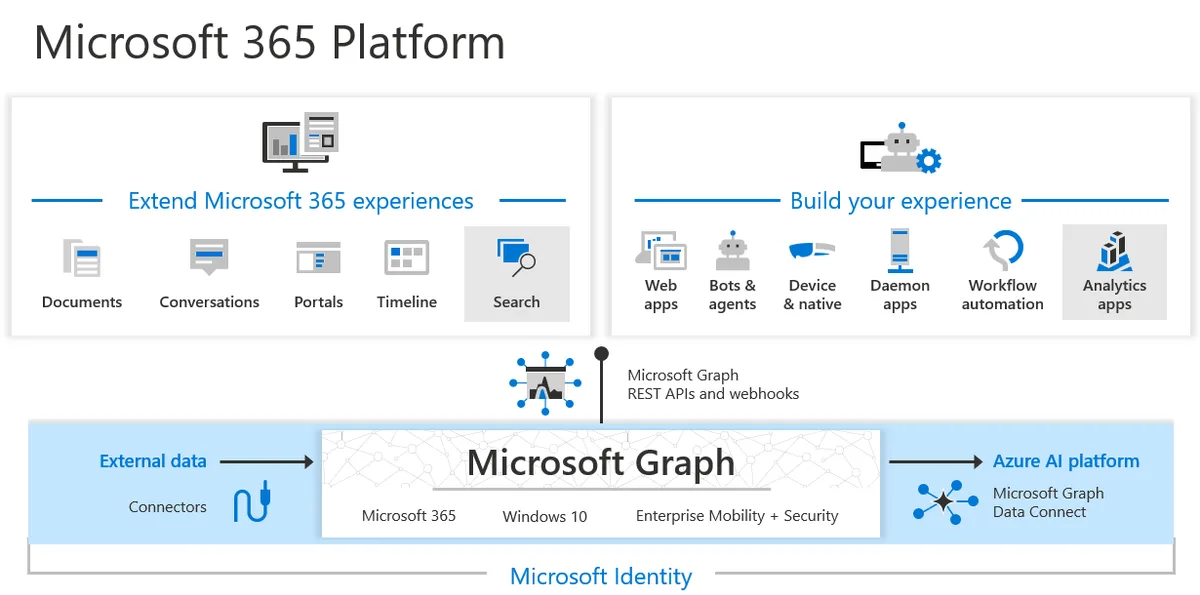
Now that we have summarized the macro areas in which Microsoft Graph operates, let’s turn to how it affects the functionality of some of the most important Microsoft 365 applications.
If you use Teams, SharePoint, and Outlook daily, you will find some pretty interesting insights in the next chapter.
What are the main integrations ofMicrosoft Graph
Let’s continue with our overview of the Microsoft 365 API and see what its features can do for your favorite work apps.
Microsoft Graph and Teams
There are two major types of integration between Microsoft Graph and Teams.
The first involves the ability to use a chatbot in the app; the second, involves sending push notifications to keep your user base informed.
Starting with the first case, Graph allows you to integrate a chatbot based on Microsoft’s artificial intelligence systems* into group and channel conversations.
*To build a chatbot, you could use Microsoft Power Platform’s Power Virtual Agents.
The inserted bot would then be able to reuse the information gathered by the API in the surrounding Microsoft environment to personalize the conversations conducted with individual users and try to fulfill their requests as quickly and precisely as possible.
To do so, it could suggest the name of contacts relevant to the situation or quote the content of specific messages saved in personal Outlook mail.
As for the second form of integration, Graph allows communications from a SharePoint site or intranet to be broadcast.
Users will thus be able to not only read the latest company posts from Teams, but also access the pages on the site where the content is located by simply clicking on the notification.
Microsoft Graph and SharePoint
Microsoft Graph enriches the functionality of the SharePoint Online-based intranet.
In particular, we are often asked by our corporate clients to expand the people directory, leveraging the information that Graph makes available that comes from employees’ Microsoft 365 accounts.
The advantage of this integration lies in the fact that personal data is transferred in real-time from Microsoft 365 to the intranet, automatically updating the profiles in the intranet.
Microsoft Graph and Outlook
The Microsoft 365 API shows some of its best sides when it comes to Outlook.
Indeed, e-mails can serve to streamline business processes, thanks to the use of applications (such as Viva Insights) capable of connecting to Graph and thus able to use the data stored in mail to:
-
Save content to certain folders in OneDrive or SharePoint.
-
Define the importance and category of incoming mail.
-
Give useful information about recipients, such as the status of their inbox (which might be full or have auto-reply enabled).
-
Suggest relevant contacts.
-
Recommend files to attach to an email.
While the capabilities born out of the Microsoft Graph and Outlook integration are potentially unlimited, we emphasize that the data on which they are based can only be made available to different Microsoft 365 apps (or even custom ones) if they are in the cloud mailbox or on-prem with a hybrid deployment.
Microsoft Graph and Microsoft 365 Copilot
If Microsoft Graph used to be a topic mainly for developers, Microsoft 365 Copilot has moved it to the center of every digital workplace conversation. The reason is simple: Copilot is only as good as the data it can reach, and the way it reaches that data is through the Graph.
When you ask Copilot a question, it does not invent an answer from thin air. It retrieves the relevant emails, documents, chats and meetings from your Microsoft 365 environment via Microsoft Graph, then uses them to ground its response. This is what makes Copilot’s output specific to your company rather than generic.
Two consequences matter for anyone planning an AI Intranet:
-
Relevance depends on Graph. The richer and better-organized your content in SharePoint, Teams and Outlook, the more useful Copilot’s answers become, because Graph has more high-quality signal to work with.
-
Security is enforced by Graph. Copilot only surfaces what a user is already allowed to open. Graph applies the existing permissions on every item, so a well-governed tenant produces safe Copilot answers. This is also why preventing oversharing in SharePoint is a prerequisite before a broad Copilot rollout.
In short, Microsoft Graph is the bridge between your corporate knowledge and the AI that now sits on top of it.
Microsoft Graph connectors: bringing external data in
By default, Microsoft Graph knows about content that lives inside Microsoft 365. But most companies also rely on systems that sit outside the suite: a CRM, a ticketing tool, a legacy file share or an internal wiki. This is where Microsoft Graph connectors come in.
A Graph connector indexes external content into Microsoft Graph so it behaves like native Microsoft 365 data. Once connected, that information becomes:
-
Searchable through Microsoft Search, from anywhere in the digital workplace.
-
Available to ground Copilot, so AI answers can draw on systems beyond Microsoft’s own apps.
-
Permission-aware, because connectors carry access rules through to the indexed content.
For an organization building a single, intelligent intranet, connectors are what turn Microsoft Graph from “the API behind Microsoft 365” into “the search and AI fabric for the whole company”, including the tools that are not Microsoft’s.
Frequently asked questions
What is Microsoft Graph used for? Microsoft Graph is the unified REST API that connects the data and intelligence across Microsoft 365. Developers and apps use it to read and act on users, files, mail, calendars, Teams messages and more through a single endpoint, while it also powers built-in experiences like Microsoft Search, personalized feeds and recommendations.
How does Microsoft Graph relate to Microsoft 365 Copilot? Microsoft 365 Copilot is grounded in your organization’s data through Microsoft Graph. When Copilot answers a question, it retrieves relevant content via Graph and respects each user’s existing permissions, so it only surfaces what that person can already access. Graph is therefore the layer that makes Copilot’s answers both relevant and security-trimmed.
What are Microsoft Graph connectors? Microsoft Graph connectors bring content from outside Microsoft 365 into the Graph, such as a third-party CRM, file share or knowledge base. Once indexed, that external content becomes searchable in Microsoft Search and available to ground Copilot, so answers can draw on systems beyond the Microsoft 365 suite.
Is Microsoft Graph free to use? The core Microsoft Graph API is included with Microsoft 365 and does not carry a separate fee for standard use. Some capabilities built on top of it, such as certain Graph connector quotas or premium Copilot features, depend on specific licenses, so confirm the current terms in Microsoft’s documentation for your scenario.
Does Microsoft Graph respect existing permissions? Yes. Microsoft Graph enforces the permissions already set on the underlying content. Whether data is surfaced through Microsoft Search, a custom app or Copilot, users only see items they are authorized to access, which is why permission hygiene in SharePoint and OneDrive matters before rolling out AI experiences.