
The Problem: A global platform to rescue, with no time to spare
The group’s internal portal, the one every employee used daily to access communications, tools and resources regardless of country or function, was hosted on an on-premise environment.
When the infrastructure changes created security issues, the client’s request was as simple as it was drastic: the platform needed a new home, and it needed it immediately.
The goal was not only technical.
Migrating to a modern SharePoint Online environment meant guaranteeing the complete transfer of all content hosted on the previous platform, while also preserving existing assets and enabling the adoption of more modern features, a smoother user experience and more effective collaboration tools. In other words, the group did not want to lose anything it had built over the years, but also wanted to come out of this emergency with something better than before.
The time pressure made every decision more delicate. This was the daily access point for a large number of employees spread across different countries, each with its own functions, tools and communications to preserve.
Prior knowledge of the client’s environment also made such a rapid response possible.
The provider handling the emergency was already a long-standing technical partner of the group, having previously built the intranets of specific countries, including the United Kingdom and Spain. This familiarity with the client’s Microsoft environment made the difference when it came to choosing who to entrust with an intervention as urgent as it was delicate: there was no time to explain from scratch how the group’s technology environment was structured to a provider unfamiliar with it.
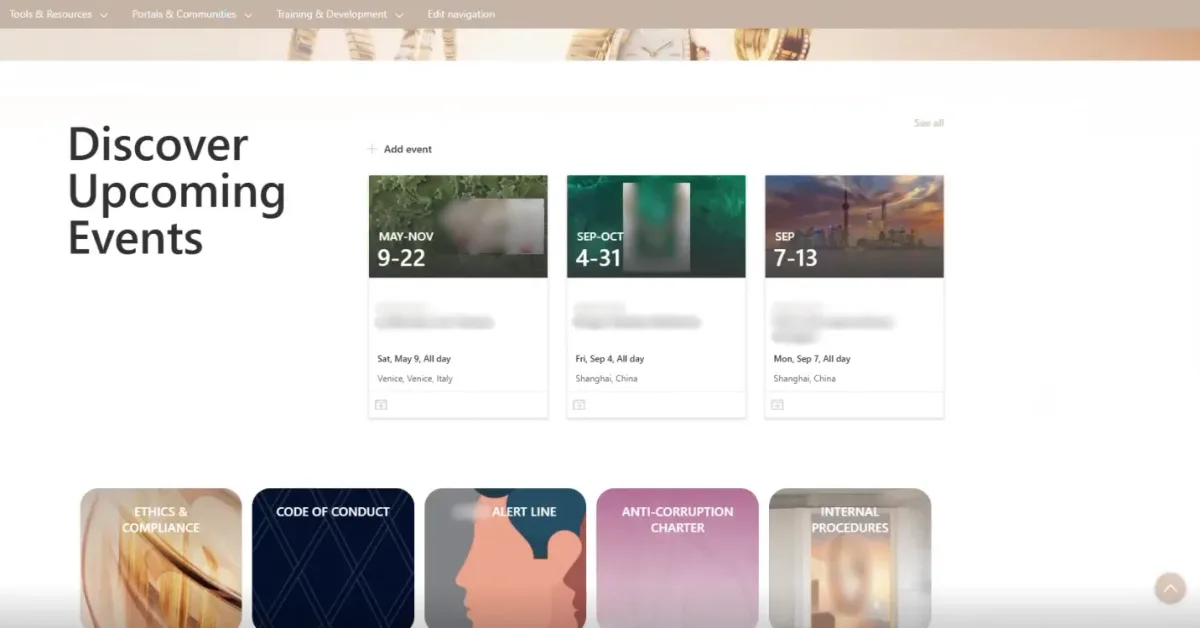
Home page of a luxury company's intranet
Our Solution: Rescue first, then enrich
The project was organised into distinct phases, each with a precise, realistic goal given the time available.
The first phase, the actual emergency, required just one week of work. In those seven days, a first working version of the intranet on SharePoint Online was created, with the navigation structure, homepage, communication components, the list of the main company applications used daily by employees, and the internal directory all taking shape together, published with the correct permissions from day one.
A result that allowed the group to never go without an essential work tool, not even for a single day.
Once the emergency was over, a second phase began, longer and more complex, dedicated to recovering and rebuilding everything that had existed on the old platform. A thorough analysis was carried out of what was present on the previous site, before proceeding step by step to rebuild the navigation menu and pages, giving users a more modern and polished experience than the starting point.
A significant part of this work involved migrating historical communications. In addition to transferring all documents, this also meant recovering two years of company communications, including announcements and news, keeping the original publication dates intact so as not to alter the chronology perceived by users.
A manual and meticulous job, made even more complex by the fact that on the old platform communications were published with a logic similar to that of a social network group, not always with an associated image or a clear link to the reference document.
In parallel, the team worked on improving the company organisational chart.
A dedicated tool was developed and integrated with the group’s information systems, along with an extension of the internal directory, introducing a differentiated view of information based on the profile of the user consulting the page. Anyone in a management role sees additional, more sensitive information about colleagues, while a standard user continues to see only basic information, such as department and role.
A dedicated site was also created exclusively for publishing news, designed to be managed independently by the client’s communication team, with predefined templates to speed up publishing, along with dedicated training sessions on both publishing content and independently updating the platform’s main components.
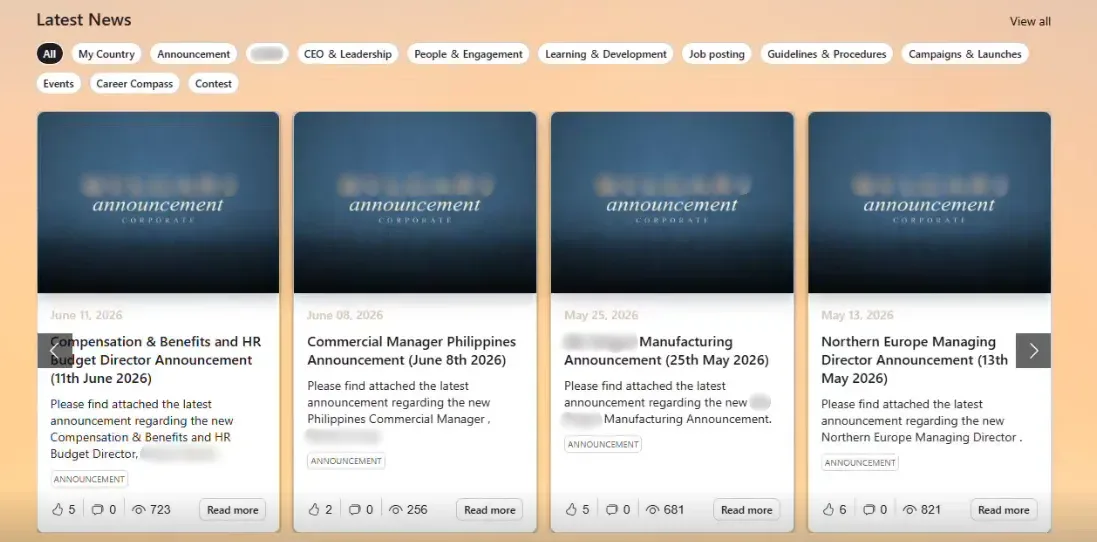
News section on the company intranet
The Results: From a critical breach to a stronger platform than before
The project went live in one week with the new platform, then continued for 5 months of intranet modernisation, culminating in the launch of a second version of the homepage, this time designed for a richer, more polished everyday experience than the first release, which had been built solely for the emergency.
During that period, 190 historical news articles were manually recovered and migrated, preserving the original chronological order of publication, a job that required precision and attention to detail given the non-standardised nature of the source content.
The fact that the group chose to continue relying on intranet.ai for this more elaborate phase, after the emergency intervention of the first week, says a great deal about the strength of the collaboration. A relationship rooted in a multi-year technical partnership, built over the years in which the provider built intranets for different countries within the group, and which made it possible to act quickly precisely because there was already a deep understanding of the client’s Microsoft environment.
Today the group manages, across its various countries and business functions, around ten distinct intranet sites, evidence of how much the platform has become an integral part of the organisation’s daily digital infrastructure, well beyond the scope of the emergency project that had marked its birth on SharePoint Online.
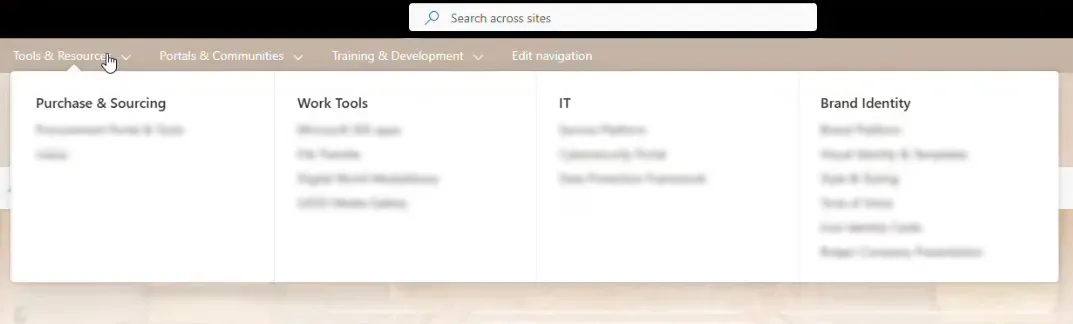
Pages and resources in the company intranet menu
What’s Next?
The group subsequently chose to move up to intranet.ai’s next plan. A move that brought with it advanced analytics tools, an intelligent assistant for managing the platform and a document management system, along with a mobile app, a read receipt system for documents and communications, and intelligent search.
A natural evolution, arriving after consolidating the platform’s foundations during the emergency and rebuilding phases.
A visual homogenisation effort for the portal is also underway. Intranet.ai’s role in this phase remains that of the go-to technical partner for everything related to SharePoint, ensuring that any future aesthetic changes remain structurally and technically solid.
When an emergency forces a migration within days, the real challenge is turning a rescue solution into a platform capable of lasting and growing in the years that follow.
Need to quickly migrate your intranet to a more secure, modern environment? Book a demo and discover how intranet.ai can step in even in the most urgent situations.