With the digital workplace, applications, data, and processes are brought together in a single, integrated, and easily accessible space. This allows companies to remain competitive over time through improved team collaboration and the optimization of internal processes.
That is why a digital workplace cannot be improvised. It requires coordination, and the best choice a company can make is to rely on a specialized consulting service.
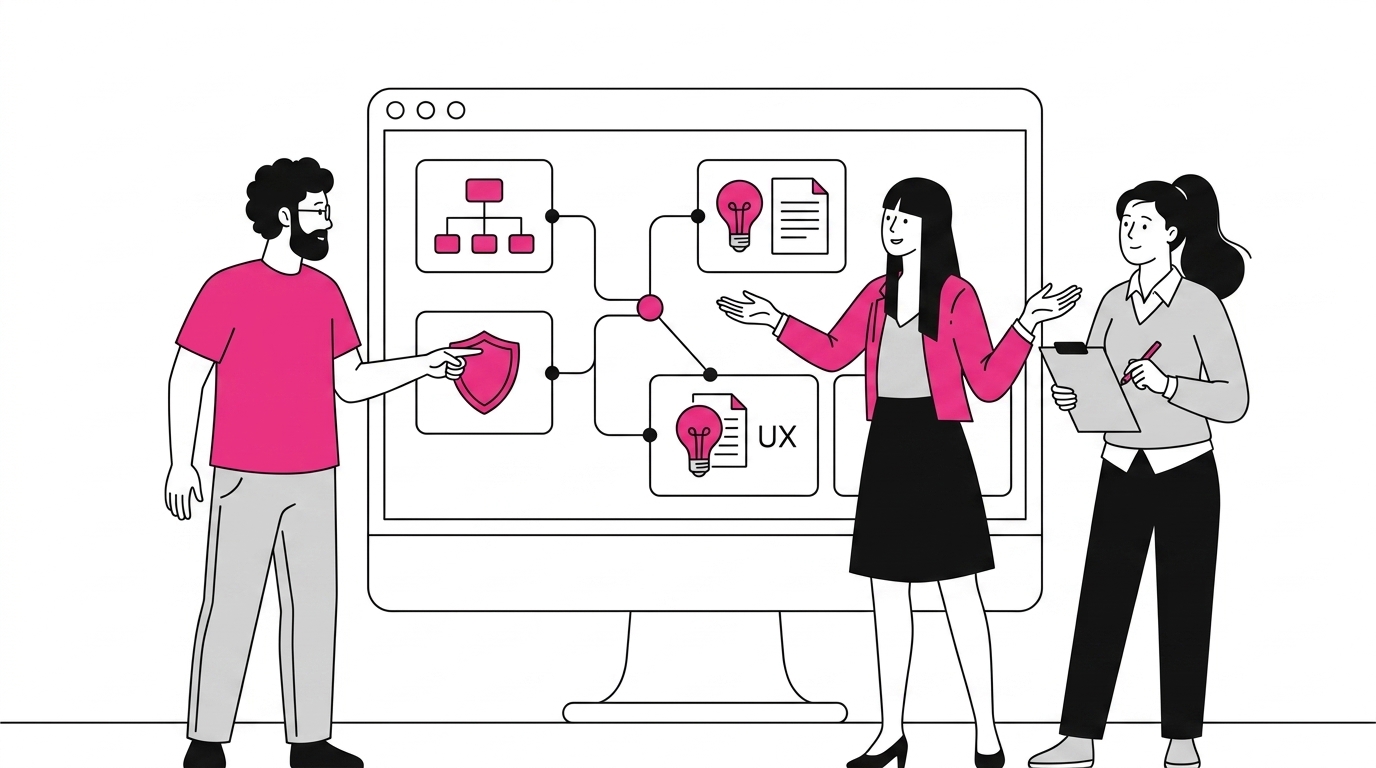
Consultants like those in the intranet.ai team can enhance the management, security, and UX of the digital workplace, giving each company the tools to improve productivity and employee well-being.
In this article, we’ll explore why it’s important to rely on specialized consultancy, what to consider when choosing the right professionals, and what you can achieve with our service.
What you will find in this article
Why companies need it
By now, every company is (or should be) a digital organization. Even though the “do it yourself” approach may seem like the most convenient option, when it comes to digital work environments (systems that bring together communication, productivity, collaboration, and corporate culture) the line between autonomy and improvisation is very thin, and often crossed without realizing it.
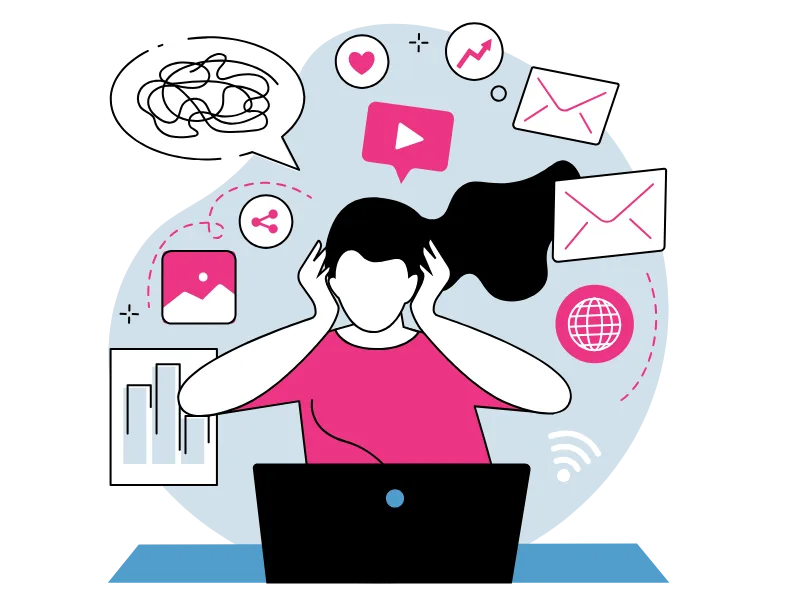
This leads to a patchwork of isolated tools, duplicated content, clunky processes that waste excessive time and energy, and internal portals that become outdated before they are even adopted.
To avoid ending up in the middle of this bleak scenario, specialized consulting services for the digital workplace have emerged in recent years.
Far from being a vague set of services, this type of consulting is highly specialized, meaning it is focused on the specific technology adopted by the company to create its digital workplace, such as Microsoft 365 applications and the SharePoint Online intranet.
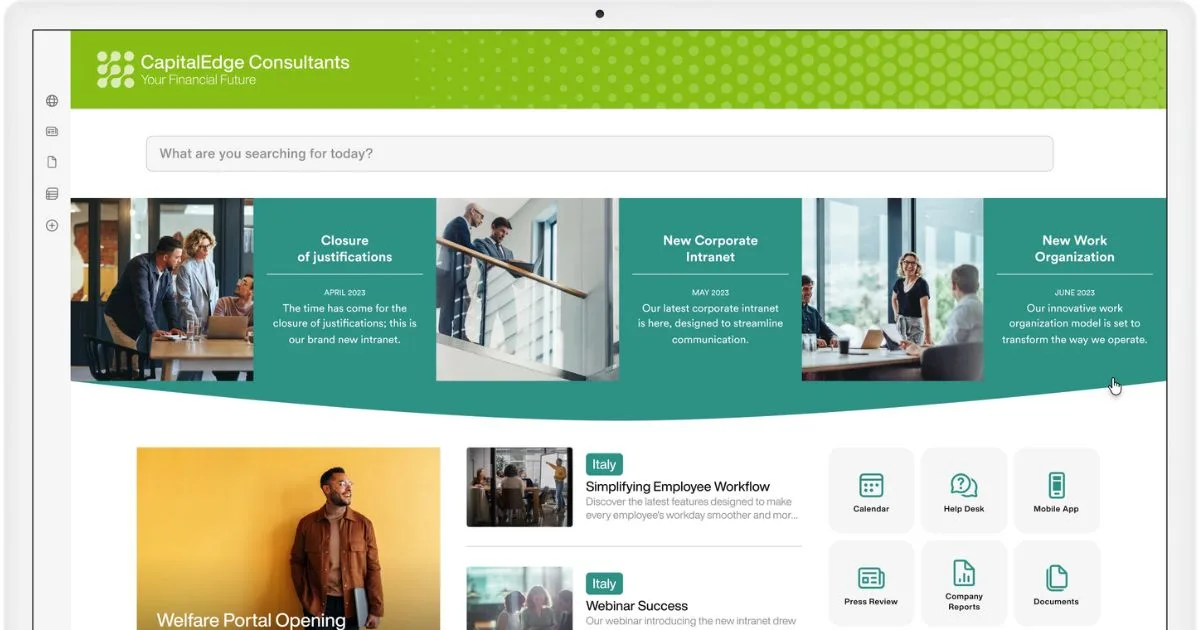
Good consulting does not just focus on setting up more efficient work environments. It also:
-
identifies hidden issues,
-
connects business goals with IT infrastructure,
-
restores order where data and knowledge are fragmented.
Because in the end, every digital workplace fails for the same reason: too many decisions are based on gut feeling. What is missing, as we mentioned, is clear direction.
Those who design a digital workplace from scratch often start with a reasonable idea: “We already have Microsoft 365 (or other technologies), we can build everything internally.” It is true that an ecosystem like Microsoft’s offers cutting-edge, well-documented tools that can potentially be adapted to any context. However, the reality is much more complex.
SharePoint Online, Teams, Viva, Power Automate, Forms, OneDrive, Loop,… all the applications that make up the suite have their own logic, permissions, dependencies, and specific behaviors. Without expert coordination, the most common outcome is a technological patchwork of questionable value.
Instead, technology should be seen as a collection of musical instruments. Each one may sound great on its own, but they will never manage the complexity of a symphony.
You need someone to conduct, returning to our metaphor.
But even here, caution is necessary.
Some companies rely on general providers such as:
-
general system integrators,
-
software houses that work with SharePoint but not exclusively,
-
IT agencies that apply the same method to every client as if it were an assembly line.
A general consultant may be able to install a web part, customize a graphic theme, or create a list, but they are unlikely to design an information architecture that takes into account document workflows, governance, access levels, user adoption, and integration with the rest of the Microsoft 365 environment.
In other words, even if a general consultant can help set up the site, they are not the right person to build a digital workplace that is coherent, efficient, and sustainable. The greatest risk is investing months and resources into a project that meets technical requirements but brings no real improvement.
The digital workplace would exist, but no one would actually use it.
Email would remain the dominant communication channel, documents would still only circulate as attachments, and the same questions would keep going to the same people who have already answered them hundreds of times.
The organization would keep working the same way as before.
Just with a few more tools to manage.
Specialized consulting services like the one provided by the intranet.ai team are designed to solve this problem by offering continuous technical support and carefully planning internal needs to define the best strategy for implementation, adoption, and improvement.
In the case of intranet.ai, this is complemented by the opportunity to start with a complete solution for the digital workplace, capable of offering (without additional development costs) all the features that have proven to be the most effective over decades of experience in improving productivity, engagement, and employee well-being.
What intranet.ai brings to the table is certified technical know-how and a proven strategy, resulting in a digital workplace that is functional and tailored to both the user and the company.
The client receives a complete project, with measurable goals, clear milestones, and decisions guided by best practices developed through collaboration with hundreds of companies of all sizes, sectors, and nationalities.
Where do we begin? With the right questions:
-
What information do colleagues need every day?
-
How is internal knowledge shared?
-
Where do decision-making flows get stuck?
-
Which tools need to be integrated?
Technology comes only afterward.
This method allows companies to truly stand out in their market, because when their digital workplace is well designed:
-
They reduce the time spent searching for information and interruptions in daily workflows,
-
They improve collaboration across teams and departments, even if geographically dispersed,
-
They maximize the return on new technologies, with higher user adoption rates,
-
They strengthen the sense of belonging and the internal community.
An effective digital workplace is born from the overall design more than from the individual platforms. It requires a digital environment architect who can balance structure and flexibility, propose modular solutions always grounded in a solid framework: clear permissions, shared processes, secure governance, useful content, and well-distributed communication.
This means every decision, from the placement of a web part to the naming of a site, is aligned with the context, the audience, and the expected outcome.
The user experience is also carefully designed, because a digital workplace that goes unused is a wasted investment. And it often takes very little to end up in that situation: a mislabeled button, a missing filter, a page that takes three extra clicks to reach.
Consulting companies like intranet.ai help organizations identify user behavior and needs: shared digital habits, meaningful automations, user experiences that don’t require a manual. This is the true value of the service: making an advanced digital workplace feel transparent, intuitive, and fully integrated into everyday work.
Finally, speed of delivery.
A project run with intranet.ai doesn’t involve months of meetings, endless mockup exchanges, or dead-end testing cycles. Thanks to a proven library of solutions already integrated with Microsoft 365 and Viva, clients can get a fully functional digital workplace in just a few days, customized based on the needs defined during the analysis phase.
This leads to a faster go-live, a smoother adoption curve, and a quicker return on investment. Most importantly, internal staff are not overwhelmed by a project that drains resources and attention for an undefined period of time.
In the next chapter, we’ll see how all this translates, concretely, into the recovery and relaunch of already existing digital environments.
It’s not always necessary to start from scratch. Sometimes, you just need to know where to step in.
See intranet.ai in action
A ready-to-use intranet on SharePoint Online, live in days. Book a free demo with our team.
Book a demoWhat our consultants have to say about managing the digital workplace
There comes a time when every company that has adopted Microsoft 365 stops and asks itself: is the digital environment I’ve invested in really working?
SharePoint sites are being visited, Teams is used every day, OneDrive folders have grown enormously, and yet the digital workplace seems to have fallen short of expectations.
Documents get lost, processes remain fragmented, and colleagues complain they can’t find what they need.
The technology is there, but it’s not generating value.
In most cases, this happens because the adoption of new technologies was not designed as a system, but as a collection of short-term responses. Each department requested its own site, each project created its own channel, and each need was addressed with a separate, isolated tool.
The result is a crowded and unstructured environment, where connections between elements are weak or nonexistent.
This is exactly when consulting becomes important.
Often, there’s no need to start over. What’s needed is to understand what isn’t working, why, and what actions can restore balance to the entire ecosystem.
Before taking action, it is essential to identify the signs.
In a digital workplace that is already up and running, dysfunctions are not always obvious, but they leave clear traces. Multiple versions of the same file appear, internal searches return irrelevant results, permissions are chaotic, and workflows are often bypassed.
Colleagues, instead of using the platform, resort to workarounds: they share via email, save files locally, and create Excel sheets to track activities that should be automated.
Another clear sign is the low adoption of features.
Microsoft 365 offers unique tools (just think of Power Automate, Planner, Lists, Viva Engage), and if these remain unused, it means the digital environment was not designed around the actual habits and needs of its users. Typically, what’s missing is a core element, that is, a well-designed information architecture to guide activities.
Every effective digital workplace starts with a solid structure, including a consistent hierarchy of SharePoint sites, a clear logic for managing permissions, and a shared taxonomy for content.
However, in many organizations, what you find is a proliferation of spaces built on demand, with no common rules. Each site has its own navigation, each area uses different labels, and users don’t know whether to search for a document in the intranet, the project team, or their inbox.
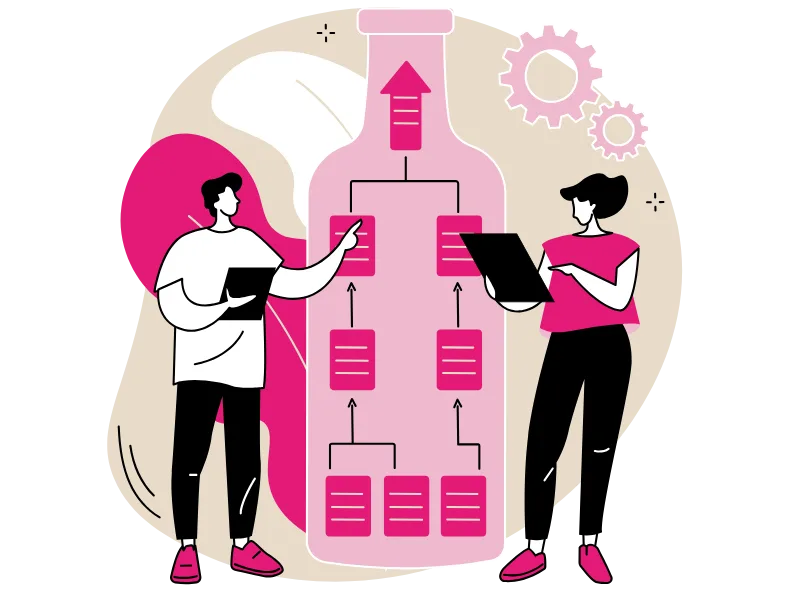
It becomes necessary to map the existing environment, identify overlaps, analyze navigation paths, and redesign the information structure to make it more coherent and intuitive.
The principle is simple: users must always know where to go to find what they need, what to expect from each available tool, and how up to date the content they are using is.
Once the structure has been redefined, the next step is the management of the digital workplace.
Many companies believe that simply launching an intranet or activating Teams will immediately lead to better collaboration and productivity. In reality, without a clear operational model, every feature clashes with old habits.
This is where a dedicated consulting service helps design an active governance model that includes:
-
Naming and versioning rules
-
Automated approval workflows
-
Retention and archiving policies
-
Indicators to monitor usage and adoption
-
Criteria for the creation and maintenance of sites and teams
The digital workplace is never a static project. It is a living environment, evolving every day. And like any environment, it needs smart maintenance. The goal of consulting is precisely this: to turn technical management into a smooth, adaptive process.
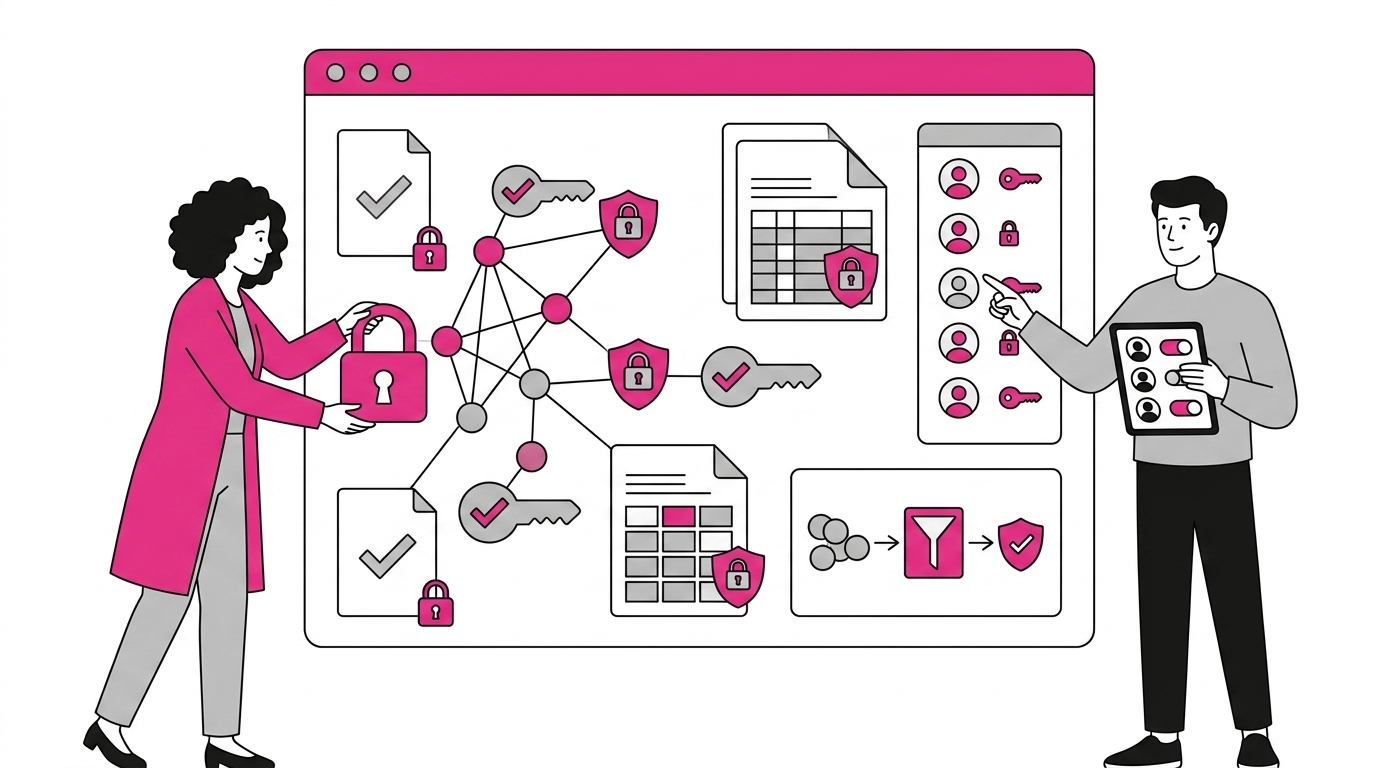
Another critical aspect in already active projects is security.
Over time, permissions granted in emergencies become permanent, external users gain access to content that is not meant for them, and sensitive documents are shared without traceability. Not due to bad intent, but because of a lack of control.
With its clients, intranet.ai has always addressed digital workplace security strategically. By analyzing access groups, identifying vulnerabilities, and proposing a permissions model based on roles and responsibilities, integrated with Microsoft 365’s authentication and monitoring systems.
Above all, all of this must happen without slowing down operations. Through periodic audits, Data Loss Prevention rules, advanced logs, and automated alerts, the environment is brought back under control while remaining agile.
Identity management and remote access are also fine-tuned to ensure the digital environment can be used from anywhere, without compromising the privacy of shared data.
What makes every intervention sustainable is ultimately the attention given to the user experience.
You can have the best portal possible, but if employees don’t feel it belongs to them, they will abandon it. That’s why it’s not enough to work only on the technical side. Communication, training, and behavior must also be addressed.
An essential part of the recovery involves engagement.
This includes analyzing usage behavior (with tools like Intranet Analytics), collecting feedback, launching internal communication campaigns to relaunch the platform, and integrating training into daily activities with easy-to-digest content like video pills and lessons based on the microlearning method.
In this way, the digital workplace becomes a living ecosystem once again.
In the next chapter, we’ll see how, as an alternative to restructuring, one can choose to migrate to a platform already designed according to our best practices. It’s a ready-to-use yet flexible intranet solution that minimizes the time and cost required to adopt a Microsoft 365-based digital workplace.
What is the value of the service offered by intranet.ai?
It is not always worth patching up something that was poorly designed in the first place.
Many digital ecosystems, built under last-minute pressure or through isolated initiatives, simply are not worth saving.
Redistributing permissions, renaming taxonomies, moving files into better-organized folders… ends up resembling a sliding puzzle: as soon as one piece fits into place, another one is left out. When the effort becomes too exhausting, the best solution is to start over, laying more solid foundations and defining the strategy from the very beginning.
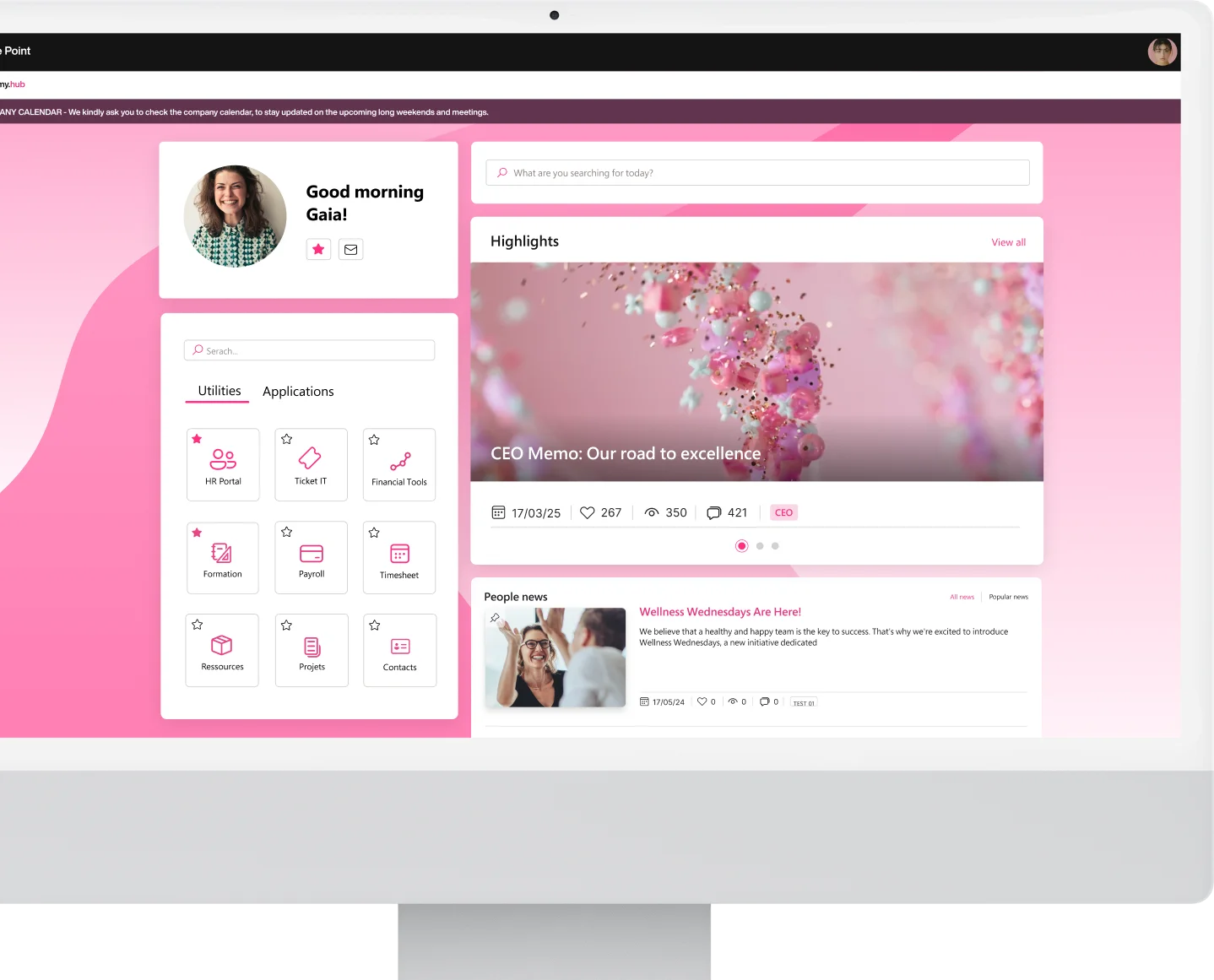
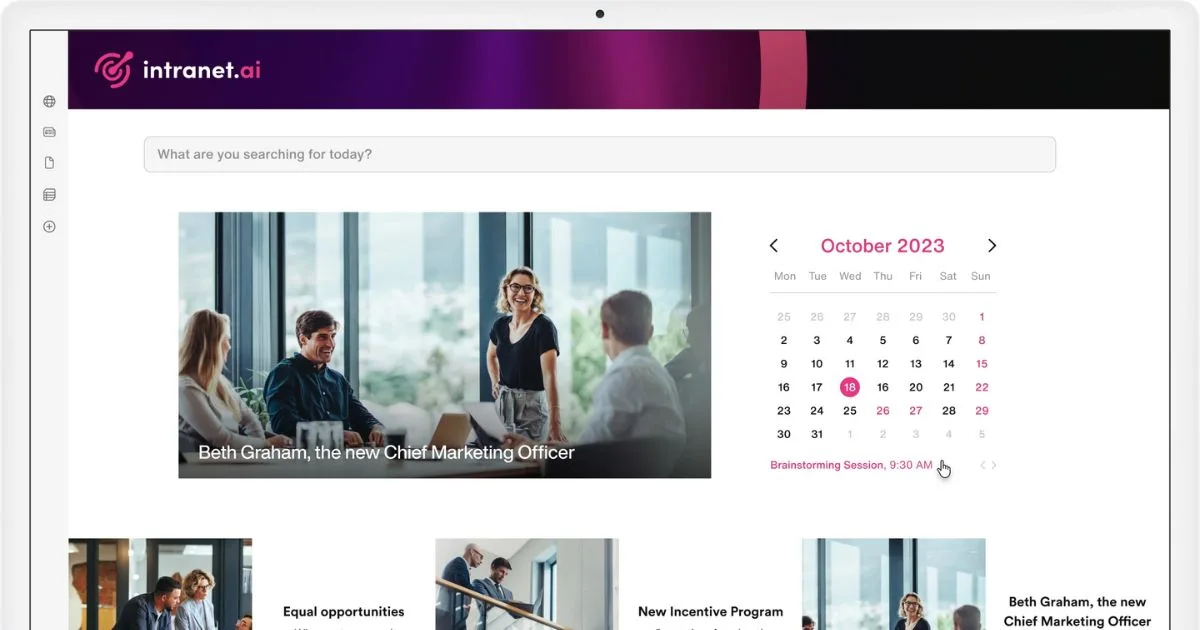
This is where the support of intranet.ai can make a real difference, with a SharePoint Online intranet solution ready to operate as a complete, scalable, and functional digital workplace.
It is the result of years of work across hundreds of projects, where every component (from the homepage to libraries, from the people directory to approval workflows) has been optimized to meet the most common needs of organizations. And, most importantly, to work right away.
A solution like this proves especially useful when maintaining the current digital workplace costs more than rebuilding it, or when the IT infrastructure of the organization can no longer scale without creating inconsistencies.
The alarm bell rings when governance is absent:
-
departments have created their own isolated spaces, disconnected from the rest of the company;
-
documents are overcrowding dozens of disconnected sites;
-
internal search returns only a few irrelevant results;
-
internal business processes still rely on email;
-
adoption stagnates, just like productivity.
In these situations, as mentioned, the best (and most cost-effective) solution is to migrate to a more modern environment, where tools from the Microsoft 365, Viva, and Power Platform suites are available and work together within a coherent ecosystem.
Believing that a ready-made solution is merely a shortcut is a misconception.
In reality, intranet.ai brings companies the essence of best practices, both its own and Microsoft’s.
Every feature stems from proven models, refined project after project.
This results in five main advantages.
The benefits of intranet.ai
intranet.ai’s benefits for the digital workplace Description
Consistent architecture Everything is designed as part of a unified ecosystem, creating synergy among different modules.
Minimized implementation time Our SharePoint intranet solution, which forms the basis of the digital workplace, is accessible within 24 hours and includes ready-to-use, vertical features tailored to core internal processes.
Ongoing evolution Our consultants continuously update the solution, following Microsoft’s latest innovations and the client’s evolving goals.
High scalability Start with a functional digital workplace and expand it with modules, without needing to redesign the entire ecosystem whenever you want to add new content or features.
Another strength of our digital workplace solution is its deep integration with the product suites within the Microsoft ecosystem.
The integrations powering intranet.ai
Microsoft suite integrated with intranet.ai Description
Microsoft 365 Our solution integrates natively with Microsoft 365, enhancing SharePoint Online as a foundational technology to centralize content, tools, and business processes. The integration with Microsoft Teams enables real-time internal communication, while Outlook integration allows for calendar synchronization and more efficient email management. Thanks to Microsoft Graph, users enjoy an intelligent experience tailored to their needs, simplifying access to critical information.
Microsoft Viva A highlight is the integration with Viva Connections, which gives users direct access to the intranet within Microsoft Teams. This allows easy access to news, resources, and apps without leaving Teams. Viva Connections also provides a unified experience with a personalized feed that aggregates content from the intranet, Viva Engage, and other Microsoft 365 or third-party apps, spotlighting the most relevant information for each user.
Microsoft Power Platform intranet.ai integrates seamlessly with Power Platform to streamline and customize internal processes without coding. With Power Automate, our team supports the automation of workflows in SharePoint (notifications, approvals, data sync, and more). Power Apps allows the creation of custom applications for task management based on existing lists and libraries. Lastly, Power BI makes it possible to embed interactive dashboards into intranet pages, providing real-time access to KPIs and analytics.
When we talk about migration, we’re not just referring to replacing existing technology. We mean a cultural shift within the company, where transparency, collaboration, engagement, and instant access to information become essential pillars.
To support this transformation, our consulting service goes beyond deployment.
We help clients run internal promotion campaigns, adoption webinars, targeted training sessions, and analysis workshops to verify whether the new digital workplace truly meets user needs.
Instead of investing in an asset that requires constant maintenance just to stay afloat, energy is focused on an environment that starts delivering value even before it goes live.
Our solution also addresses two key uncertainties:
-
Project ambiguity.
-
Unpredictable costs.
The functional scope is clear, timelines are fixed, the budget is transparent, and the ROI is measurable.
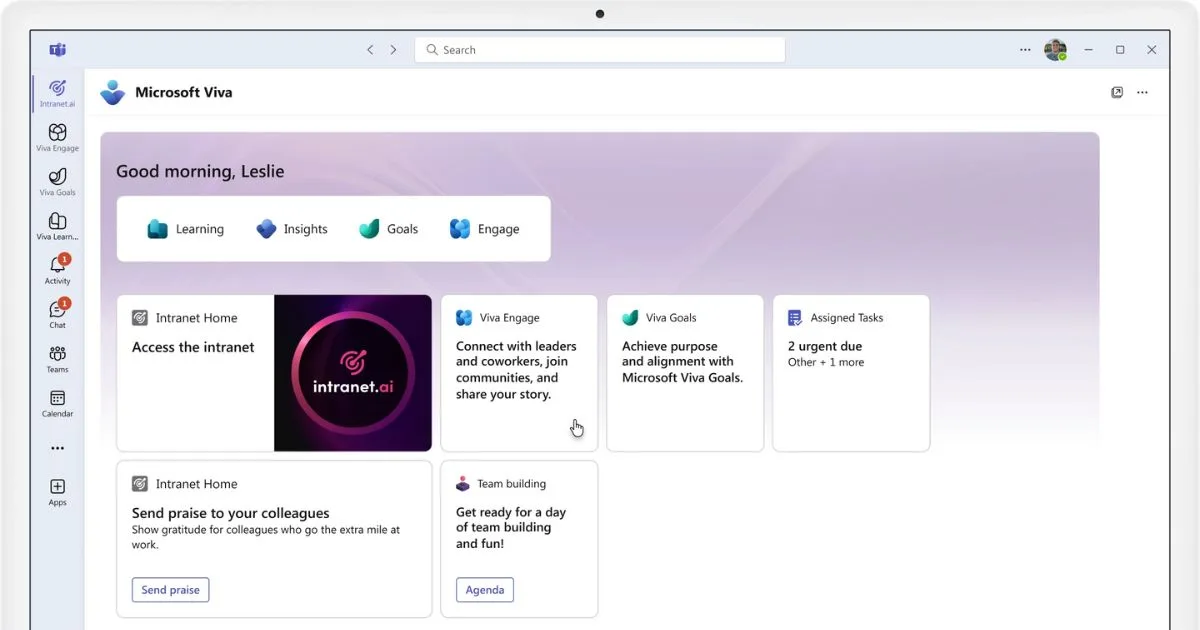
When we talk about high-performing digital environments, the focus is often on usable interfaces, well-connected workflows, and carefully designed integrations. But there is one element that is now reshaping the entire game: artificial intelligence.
AI, especially when integrated into the Microsoft 365 ecosystem, has become a practical tool accessible to any user.
Microsoft Copilot is the proof of that.
The assistant developed by Microsoft is able to:
-
read and interpret the operational context;
-
identify and reprocess complex data;
-
suggest how to bridge internal gaps;
-
generate relevant content;
-
and more.
Learning every day from the people who use it.
Back to intranet.ai’s consulting services: Copilot is not treated as just a novelty to use at work “because it’s there.” On the contrary, it is framed as a new level of interaction between employees and information, whose adoption is planned methodically.
It is essential to understand where to introduce it, with what permissions, for which tasks, and above all, how to train users so they can use this amazing technology correctly.
intranet.ai supports each client through their unique adoption journey with a practical approach that combines targeted training, relevant use cases, and AI governance that accounts for security, compliance, and data sensitivity.
The goal is not to have everyone use Copilot, but to ensure it is used effectively where it matters.
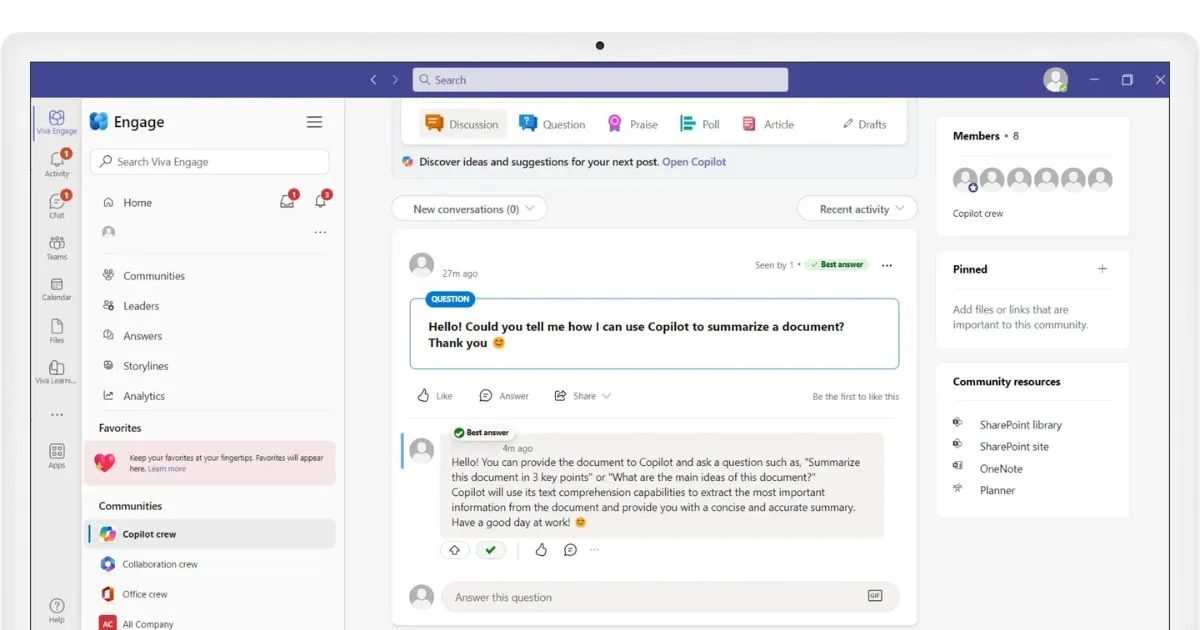
In addition to Copilot, there are other tools that are reshaping the digital workplace experience.
One of the most notable is Gaia, the conversational agent we developed to simplify the management of the intranet and the integrated digital workplace.
Unlike an assistant like Copilot, Gaia is designed for staff responsible for managing and updating intranet content and features. Integrated with Intranet Analytics, it enables the monitoring of intranet performance and the development of data-driven strategies to improve adoption and impact across the organization.
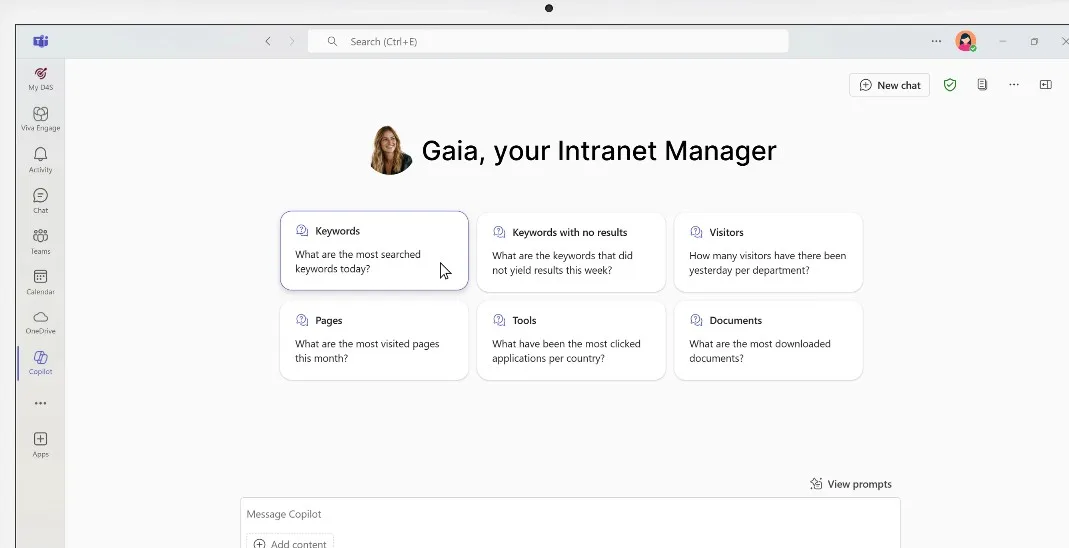
Here too, however, technology alone is not enough.
The environment must be prepared, the content from which the AI learns must be curated, interaction methods must be defined, and limits of intervention and update criteria must be established.
Introducing a virtual assistant into the digital workplace once again raises a cultural issue, because using such a tool in daily tasks requires trust.
For this reason, Gaia is designed according to a fundamental principle: AI must adapt to the company context, not the other way around. Each installation is tailored based on real workflows, frequently asked questions, navigation paths, and internal terminology.
The combination of Copilot and Gaia paves the way for new forms of intelligent support, such as distributed assistance, step-by-step guided processes, and navigation based on the meaning of information. The interface becomes dynamic, able to adapt to context and real user needs, ultimately simplifying the complexities typical of every organization.
From this perspective, the digital workplace is an ecosystem that works alongside us.
And it is precisely on this foundation that we have built our vision of holistic consulting, along with a complete, modular, and immediately operational solution that avoids costly and time-consuming development while offering the flexibility to create a digital space tailored to each company.